

I’ll be straight with you: Love Story, the FX series that dropped in 2026, was not on my radar.
I’m from the same generation as John F. Kennedy Jr. — the one everyone called John John — which means I didn’t need a prestige TV series to tell me about his life. I lived through it, in real time, through magazine covers and breaking news and that suffocating feeling of watching a tragedy unfold in slow motion. The crash. The search. The grief. So why would I willingly sit down and watch it all again, packaged in cinematic lighting and a carefully curated soundtrack?
Because of two words: Love Story.
A Title Is Never Neutral
Think about what the show isn’t called.
It’s not The Last Flight. Not Camelot’s End. Not John and Carolyn. Not even something elegant and ambiguous like July 1999.
It’s Love Story — which is one of the most loaded phrases in the Western cultural imagination. It promises you something. It promises you a beginning, a middle, and — here’s the catch — an ending that means something. It promises Cinderella. It promises Romeo and Juliet (and yes, I know how that ends, thank you very much, but we romanticise it anyway). The title insists on a frame before the first scene even begins. It tells you: this was a love story. It was epic. It was fated. It was worth watching. And that’s the first act of narrative construction I want to talk about — because what the FX series does is build a myth around two real people who never got to write their own ending.
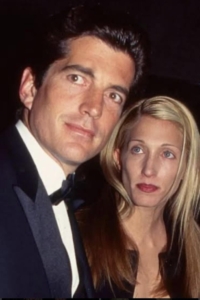
John F. Kennedy Jr and Carolyn Bessette
The Kennedy Myth Machine (And Why It Never Stops Running)
John John’s life was, functionally, a real-time documentary before anyone knew what that was. Born under a flashbulb. Photographed at three years old saluting his father’s coffin — an image that entered the collective unconscious and never left. Grew up to be impossibly handsome, impossibly well-educated, impossibly everything, and every step of the way, the cameras were there.
His life had a narrative before he was old enough to choose one.
And Carolyn? The series shows us a woman who enters this gravitational field. Brilliant, beautiful, fiercely private, she inevitably gets shaped by it. You can watch her becoming the character the story requires rather than the person she might have chosen to be. The modern prince needs his princess. The myth needs its heroine. The love story needs its second lead.
She knew it. By all accounts, she resisted it. And still, she was absorbed. This is not a criticism of the series. It’s actually its most honest moment.
The Curse, the Greeks, and What We Actually Inherit
The plane went down in 1999 and, right on cue, the press resurrected the Kennedy curse.
I don’t believe in curses. Not in the cosmic sense, not in the “the gods are punishing this family” sense. But I believe — deeply, with everything I know about writing and narrative and the way stories shape human behaviour — that internalized narratives are more powerful than any curse.
The Greeks understood fate as something external. Immovable. Imposed by the gods, written in the stars, non-negotiable. In Oedipus Rex, every attempt to escape the prophecy is the very road that leads straight to it. The tragedy isn’t that Oedipus is weak — it’s that he never had a chance. The ending was already written.
We don’t live in that world. But here’s what I think does happen, and it’s subtler and more interesting than divine punishment: When you grow up inside a story — when your family carries a mythology, when the media codes every new loss as “the curse strikes again,” when the very word Kennedy arrives pre-loaded with tragedy — you start to make choices that confirm the narrative. Not because you’re stupid or passive. Because that’s what stories do. They create grooves. They make certain paths feel inevitable.
Oedipus didn’t know he was inside a myth. That’s the tragedy of his tragedy.
We know. And that changes everything.
The Thing That Actually Gives Us Agency
Here’s what I’ve learned — through writing, through therapy, through the years of sitting with other people’s stories and my own — about the moment things shift:
It’s not when you “escape” the narrative. You can’t always do that.
The moment you can say “ah, this is the story I’ve been living inside — this is the frame I inherited, the mythology I absorbed, the script I’ve been performing without auditioning for the role” — that’s the moment the grip loosens, even a little.
John-John grew up being told, in a thousand subtle and not-so-subtle ways, that he was a Kennedy, and Kennedys were marked. Carolyn entered a story that was already in motion, already cast, already titled. Neither of them had the luxury of stepping outside it and asking: “whose story is this, really?”
We do. That’s the underrated gift of self-awareness — not that it protects you from pain, but that it lets you choose your pain consciously rather than sleepwalking into someone else’s script.
So What Do We Do With Love Story (The Show)?
Watch it if it calls to you. But watch it the way I’d ask you to watch anything that presents a real life as a coherent narrative: with one eye on the story, and one eye on the *storytelling*.
Notice how the title frames everything before a single frame runs. Notice which choices are presented as inevitable, which as romantic, and which as doomed. Notice what Carolyn’s interiority costs to tell, and how much of it remains opaque because the series — like the culture itself — is ultimately more interested in the myth than the woman.
And then, when the credits roll, ask yourself: “What title would I give the story I’m living right now?”
Not the story your family assigned you. Not the one the culture is writing about people who look like you, love like you, age like you. The one you would write, if you held the pen.
Because in the end — and this is the thing I believe with everything I have — the narrator shapes the story more than the events do.
Co-Creative Writing — a tool for consciousness, one story at a time.
 Christina Oiticica